Eventos del diagrama de flujo de proceso
 |
 |
 |
 |
Este artículo es válido para el nuevo menú unificado Proceso (PM063) en la versión 3.0 del sistema:
- Acceda a la documentación de release notes para obtener más detalles sobre los cambios significativos en la unificación del menú.
- Haga clic aquí para acceder a la documentación válida para el menú antiguo de registro.
Prerrequisitos
- Acceso al menú Proceso (PM063).
- Proceso previamente registrado.
- Diagrama de flujo previamente modelado.
Introducción
En el diagrama de flujo de proceso, los eventos representan acontecimientos que pueden iniciar, finalizar, interrumpir o tratar errores durante la ejecución del flujo.
Este artículo abordará los siguientes tipos de eventos:
- Eventos de inicio: definen el punto de partida del proceso.
- Eventos intermedios: interfieren en la ejecución del flujo y pueden desviar o condicionar su continuidad.
- Eventos de finalización: determinan el fin del proceso y su impacto en el flujo general.
A continuación, explicaremos cómo acceder a los eventos y mostraremos los iconos y las descripciones de cada uno.
Acceder a los eventos del diagrama de flujo
1. Para acceder a los eventos del diagrama de flujo de proceso, acceda al menú Proceso (PM063).
2. Localice el proceso deseado y haga clic con el botón derecho del mouse sobre él.
3. Seleccione la opción Abrir diagrama de flujo.
4. En la pantalla del diagrama de flujo, acceda a la sección Ítems, localizada en el lado izquierdo de la pantalla, en la que los eventos están listados.
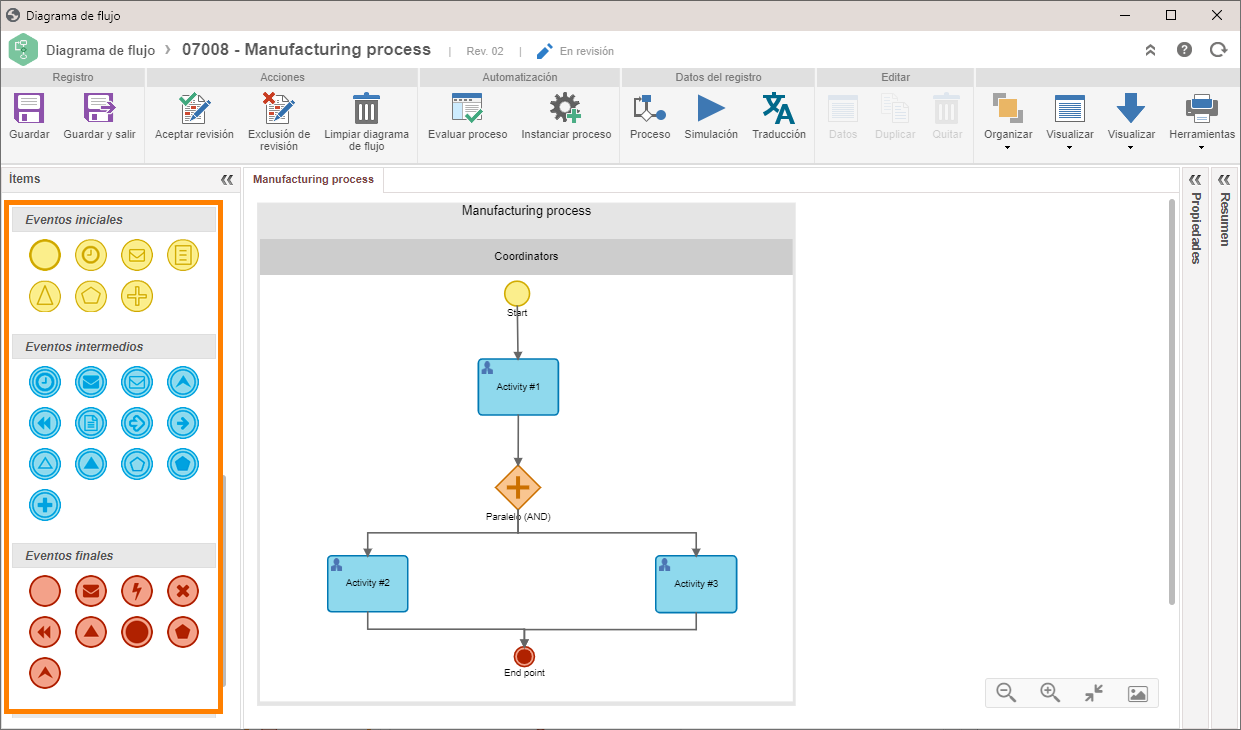
A continuación, vea los eventos iniciales, intermedios y finales, junto con sus iconos y descripciones:
Evento inicial
El evento inicial define el punto de partida del proceso, esperando la ocurrencia de un evento para activarlo.
En subprocesos eventuales, una línea continua indica que el proceso principal se interrumpirá, mientras que una línea discontinua significa que el flujo comenzará en paralelo sin interrumpir el proceso principal.
| Icono | Evento | Descripción |
|
Inicio | Este evento indica que el proceso será iniciado en un período predeterminado, es decir, el proceso se iniciará por una condición de tiempo (fecha relativa o período). |
|
Timer |
Este evento establece que el proceso se iniciará automáticamente en función de una condición de tiempo previamente definida, como una fecha relativa o un período específico. Este evento permite edición. Para obtener más detalles, consulte el artículo Editar los datos de los eventos. |
|
Mensaje | Este evento indica que el proceso se iniciará cuando se reciba un mensaje. |
|
Condicional |
Este evento indica que el proceso se iniciará cuando se cumpla una condición lógica. Obs.: este evento se utiliza solo para fines de registro y documentación y no tiene automatización en el workflow. |
|
Señal | Este evento indica que el proceso se iniciará al capturar una señal proveniente de otro proceso. |
|
Múltiple |
Este evento indica que múltiples eventos pueden iniciar el proceso; sin embargo, solo se necesita que uno de ellos se produzca para que se inicie el proceso. Obs.: este evento se utiliza solo para fines de registro y documentación y no tiene automatización en el workflow. |
|
Múltiple paralelo |
Este evento indica que el proceso solo se iniciará después de que se hayan producido múltiples eventos, y todos deben ocurrir. Obs.: este evento se utiliza solo para fines de registro y documentación y no tiene automatización en el workflow. |


Evento intermedio
El evento intermedio indica un punto del flujo en el que está previsto que se produzca un evento. Cuando se usa para esperar un evento, el marcador es blanco. Cuando se usa para lanzar el evento, el marcador es oscuro.
| Icono | Evento | Descripción |
|
Timer | Este evento indica que el proceso esperará una condición de tiempo para continuar el flujo. |
|
Mensaje (enviar) |
Este evento indica que se enviará un mensaje, permitiendo el envío de mensajes estandarizados por medio de templates. Estos mensajes contienen información insertada en los datos del proceso durante su ejecución. |
|
Mensaje (recibir) |
Este evento indica que se debe recibir un mensaje. El proceso esperará la recepción del mensaje para continuar el flujo. |
|
Escalamiento |
Este evento indica que el proceso está pasando por una excepción de negocio, lanzando el evento para ser capturado por el proceso de nivel superior. Obs.: este evento se utiliza solo para fines de registro y documentación y no tiene automatización en el workflow. |
|
Compensación |
Este evento indica que el proceso ha entrado en una situación que requiere compensación, lanzando el evento para que el proceso padre realice la compensación. Obs.: este evento se utiliza solo para fines de registro y documentación y no tiene automatización en el workflow. |
|
Condicional |
Este evento indica que el proceso quedará pausado hasta que una determinada condición se vuelva verdadera. Obs.: este evento se utiliza solo para fines de registro y documentación y no tiene automatización en el workflow. |
|
Link (recibir) |
Este evento permite una conexión más organizada entre dos extremos del flujo dentro del mismo proceso. Para cada evento de link de recepción, debe haber al menos un evento de envío. |
|
Link (enviar) |
Este evento permite una conexión más organizada entre dos extremos del flujo dentro del mismo proceso. Para cada evento de link de envío, debe haber un evento correspondiente de link de recepción. |
|
Señal (recibir) |
Este evento indica que el proceso esperará la recepción de una señal para continuar el flujo. |
|
Señal (enviar) |
Este evento indica que, durante la ejecución, se emitirá una señal para otro(s) proceso(s). |
|
Múltiple (recibir) |
Este evento indica que se espera la ocurrencia de múltiples eventos y que cualquiera de ellos podrá iniciar el flujo derivado del evento. Obs.: este evento se utiliza solo para fines de registro y documentación y no tiene automatización en el workflow. |
|
Múltiple (enviar) |
Este evento indica que, durante la ejecución, se lanzarán múltiples eventos. Obs.: este evento se utiliza solo para fines de registro y documentación y no tiene automatización en el workflow. |
|
Múltiple paralelo |
Este evento indica que son esperados varios eventos para continuar el proceso (catch), y todos deberían ocurrir para que el flujo continúe. Obs.: este evento se utiliza solo para fines de registro y documentación y no tiene automatización en el workflow. |


Los eventos Timer, Mensaje (enviar), Mensaje (recibir), Link (enviar) y Link (recibir) permiten edición. Para obtener más detalles, consulte el artículo Editar los datos de los eventos.
Evento final
El evento final marca el punto de finalización del flujo del proceso. Es posible tener más de un evento final en el mismo proceso, y solo puede lanzar un evento como la última acción.
Todos los eventos finales terminan solo la etapa del flujo en el que están incluidos. Si no hay otra etapa habilitada, la instancia será finalizada. No obstante, el Fin presenta un comportamiento diferente de los demás, ya que, al ser alcanzado, termina todo el flujo y todas las etapas en marcha.
| Icono | Evento | Descripción |
|
Fin | Este evento asegura que el proceso esté completamente finalizado, cancelando cualquier flujo paralelo. |
|
Finalizador | Este evento indica que el flujo del proceso ha llegado a su fin sin accionar ningún evento específico. Si no hay otro evento en paralelo, el evento final finalizará la instancia. |
|
Mensaje |
Este evento indica que se enviará un mensaje a otro proceso cuando se finalice el flujo. Obs.: para finalizar la instancia, este evento presenta el mismo comportamiento que el evento final Finalizador. |
|
Error |
Este evento indica que el proceso ha finalizado debido a un error desde el punto de vista de negocios de la organización. Obs.: este evento se utiliza solo para fines de registro y documentación, no tiene automatización en el workflow y presenta el mismo comportamiento del evento final Finalizador. |
|
Cancelar |
Este evento indica que se ha cancelado la ejecución del proceso. Obs.: este evento se utiliza solo para fines de registro y documentación, no tiene automatización en el workflow y presenta el mismo comportamiento del evento final Finalizador. |
|
|
Compensación |
Este evento indica que el proceso se ha finalizado con necesidad de compensación. Obs.: este evento se utiliza solo para fines de registro y documentación, no tiene automatización en el workflow y presenta el mismo comportamiento del evento final Finalizador. |
|
Señal |
Este evento permite finalizar el proceso, enviando una señal para otro(s) proceso(s). Esta señal se puede capturar por las actividades o los eventos de recepción de señal en otros procesos. Obs.: para finalizar la instancia, este evento presenta el mismo comportamiento del evento final Finalizador. |
|
Múltiple |
Este evento permite lanzar múltiples eventos al final del proceso, y todos deben ocurrir. Obs.: este evento se utiliza solo para fines de registro y documentación y no tiene automatización en el workflow. Para finalizar la instancia, debe tener el mismo comportamiento del evento final Finalizador. |
|
Escalamiento |
El subproceso se finaliza con una excepción de negocio, lanzando este evento para ser capturado por el proceso de nivel superior. Obs.: este evento se utiliza solo para fines de registro y documentación y no tiene automatización en el workflow. Para finalizar la instancia, debe tener el mismo comportamiento del evento final Finalizador. |


Conclusión
Ahora usted ya conoce todos los tipos de eventos y cómo funcionan en el diagrama de flujo del proceso. Vea también cómo montar el diagrama de flujo del proceso.